Thursday, August 14, 2014
On Wearing Bright Clothing While Walking
We are often advised to wear bright clothing while walking, especially when walking at night. This is so important that the Department of Transportation, in its reports on collisions involving people walking, classifies victims according to the clothing they were wearing: "mixed," "dark," "light," or "missing" ("missing??"). There are also a couple categories for different types of reflective clothing.
In Seattle, lots more people wearing dark or "mixed" clothing are hit while walking than people wearing light clothing, and in 2011, only six people wearing reflective clothing were hit while walking (Seattle Department of Transportation 2011 Traffic Report, p. 7-21).
I do see a lot of people walking around at night in dark clothing. For example, people coming out of the Seattle Opera and the Pacific Northwest Ballet at night often wear dark clothing. This is also true of symphony patrons at Benaroya Hall.
For the sake of safety, these organizations should provide reflective vests for patrons to wear as they walk out onto the street.
It would also be advisable for those of us who park our cars on neighborhood streets to keep reflective vests in our cars to wear when walking to our homes.
The Traffic Report mentioned above does not give any information about the color of cars involved in collisions. I have noticed a lot of dark-colored cars driving around at night. Seattle Department of Transportation should look into this.
Friday, April 18, 2014
It's Not an Accident
It's not an accident when a person driving a pickup kills a person crossing the street.
To the Editor of the Seattle Times:
Yesterday I participated in the candlelight vigil for Sandhya Khadka, who was killed when a person driving a pickup truck struck her as she crossed the street in an unmarked crosswalk.Your story in today's paper incorrectly states that "there is no crosswalk at the intersection." In fact, by law every intersection without a traffic signal is an unmarked crosswalk, and people driving cars or trucks are required to stop for people who walk across the street.
When you refer to this tragic incident as an "accident," you imply that nothing could have been done to prevent it. The Seattle Police call it a "collision." That is a more neutral term.
Your report states that she was "hit by a pickup" and does not mention that there was a person driving that pickup until several paragraphs later, when you state that the person driving was not impaired.
The language you use to report on a tragedy shapes the discussion about how the tragedy could be prevented. I participated in the vigil to support Sandhya's grieving family, and to call on our community to work together to make our shared public streets safe for all the people who use them.
Wednesday, February 12, 2014
Not Dead! It's a Living End!
Some of the liveliest places for walking and biking in Seattle can be reached only by streets marked with big orange "Dead End" signs. This is the entrance to the Mountains to Sound Greenway trail from the new Beacon Hill Greenway on 18th. The paint on the street suggests there's something not so dead on that street, but the sign says "Dead End."
This elegant staircase connects Bellevue and Melrose on the west slope of Capitol Hill - poignant one-block reminder of the formerly grand East Harrison Hill Climb, which connected Capitol Hill with downtown. How do you get there? Ignore the "Dead End" sign at Bellevue and Republican.
Here's just one more example: This is the entrance to the bike and pedestrian tunnel along I-90, part of the Mountains to Sound Greenway. You can just make out the sign marking this major route for walking and biking; not nearly as obvious as the big "Dead End" sign as you enter the street.
One way to fix this would be to add little "except bicycles and pedestrians" signs; I've seen a few.
But I'd rather see something more positive. A street isn't "dead" when people aren't allowed to drive cars on it. Taking away car traffic makes the street come alive! How about a big bright "Living End" sign, with a little warning for drivers saying "No Cars?"
Wednesday, November 27, 2013
The Broadway Bikeway is Open - But Broadway is Still Closed to Bikes
The first section of the Broadway Bikeway (or Cycle Track, or Protected Bike Lane) opened for bicycles over one month ago. My friend and colleague Tom Fucoloro documented the opening with this video. I rode up and down the Bikeway a few times myself, just to convince myself it was real.
One month later, this lovely facility remains pretty much devoid of bikes. When I rode it yesterday, I saw just two other people in the Bikeway. One person was riding a bike; the other was a woman in an SUV who had pulled over into the Bikeway to make a phone call.
Why is the Broadway Bikeway so underutilized? I can think of a number of reasons: it doesn't really go anywhere; it ends to the north before it reaches the most active commercial section of Broadway, and to the south it ends before it reaches Pill Hill.
But there's another deterrent to using the Bikeway: nobody has bothered to take down all the signs that say Broadway is closed to bikes.
This sign is posted a couple blocks west of Broadway on the main bike route from downtown:
One block closer to Broadway, I'm instructed to use the sidewalk:
And when I finally get to Broadway, I'm given this confusing message:
The Broadway Bikeway is the most highly visible protected bike lane in Seattle.
Most people who walk, drive cars, ride buses or ride bikes on Capitol Hill have never seen a two-way protected bike path. How are people supposed to know how to behave in this unfamiliar landscape?
In the world that I imagine, from the minute construction began, there would have been signs announcing that a new, world-class facility for bikes was soon to appear. Bright banners on the construction wall along the Bikeway would have shown people how to drive, park, walk and ride bikes along the new Broadway. Instead, we just got detour notices, which nobody bothered to take down after the Bikeway opened.
Please, somebody, take down those signs. Or is it time for the Reasonably Polite Seattleites to take matters into their own hands?
Friday, October 4, 2013
Intersections: Inconsistent on Twelfth Avenue East
| Preschoolers crossing the street at 12th and Olive |
I looked at the unsignalized intersections at Howell, Denny, Thomas, Harrison, Republican, Mercer, Roy and Aloha (construction disrupted the intersection at Olive, so I left that one out except to snap the photo above of a bunch of preschoolers crossing the street).
These features were scattered among the eight intersections. Some had no improvements; some had three or four. No intersections used all of these features.
As I rode north on 12th, here's what I observed.
At 12th and Howell, the stop line for people driving cars is set back about 50 feet from the crosswalk at the intersection. There's a sign pointing out the correct place to stop, and at the corner there's a big yellow warning sign with a picture of a person walking.
| 12th and Howell, looking South on 12th |
I haven't seen stop lines positioned this far from an intersection anywhere else in Seattle; none of the other intersections along 12th have this feature. While it might be a good idea to leave this much space between moving cars and people walking, unless this feature is used consistently, it seems unlikely to me that people who drive cars will be willing to wait this far back from intersections while people cross the street.
Next comes 12th and Denny.
| 12th Ave. East and East Denny Way, looking south |
Oddly though, there are curb bulbs on the southern side of the intersection, where there's no painted crosswalk.
| 12th and Denny, looking north |
I skipped the signalized intersection at East John and went on to 12th and Thomas.
| 12th and Thomas curb bulb and parking restriction looking north |
However, there are no painted crosswalks and no warning signs here.
| 12th and Thomas curb bulb planting |
| 12th and Harrison looking north |
Here's 12th and Republican. There are no crossing improvements of any kind at this intersection.
| 12th and Republican, looking southeast |
| 12th and Mercer, looking north |
| Yellow warning sign at 12th and Mercer |
| 12th and Roy with eight-foot parking restriction |
| School zone sign at 12th and Roy looking south |
| 12th and Aloha with one-way diverter |
| Speed limit on 12th is 30 mph |
Sunday, September 1, 2013
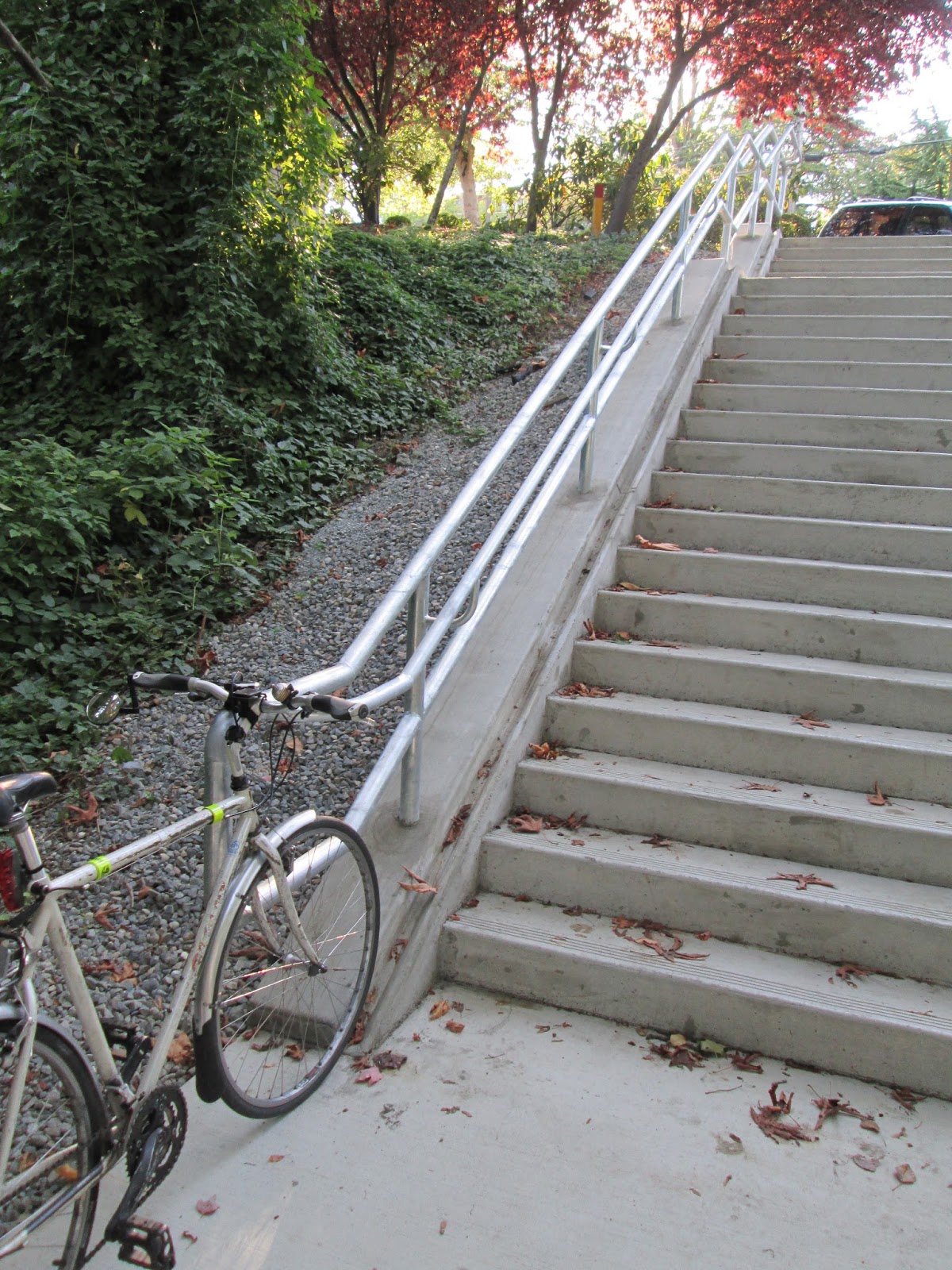
UPDATED: Staircase with Runnel for Bikes: Helpful? Maybe.
UPDATE: I often carry my bike up a different staircase - the one on 26th Ave. East at Prospect near the Arboretum. Today there was a sign at the bottom announcing that the staircase will be closed for repairs, with a number to call for more information. Karen, who answered the phone, told me that this staircase is being updated to meet ADA requirements. No, she said, it will NOT have a bike runnel. "We've built some of these, but we haven't really figured out how to make them work. So for now, we're not going to build any more...We're the do-ers , not the designers here. The engineers told us they got complaints from bikers and they figured it was better not to build them than build something that doesn't work."
Well, I guess it's good to be heard - but I would have preferred a well-designed runnel on my route home.
The long staircase that takes East Thomas Street across Madison between 25th and 26th has been rebuilt, and I was excited to see that a runnel for bikes was added.
Well, I guess it's good to be heard - but I would have preferred a well-designed runnel on my route home.
The long staircase that takes East Thomas Street across Madison between 25th and 26th has been rebuilt, and I was excited to see that a runnel for bikes was added.
But does this really make it easier to get my bike up the stairs?
I have seen pictures of runnels (also knows as bicycle stairway channels), notably in bike-friendly Copenhagen, but I hadn't ever tried to use one. So today I took my bike over to the newly rebuilt stairway and tried out the runnel.
I'm sorry to say I'm disappointed.
First of all, there's only one runnel, on the left side of the staircase when going up. If someone were trying to walk down the stairs, with or without a bike, while I was going up, we would run into each other. That's a minor problem, since there isn't a huge amount of traffic on that stairway.
More annoying, the metal railing is very close to the runnel and is just at the height of my handlebars. My handlebars catch on the railings on the landings, my mirror gets whacked out of alignment, and my pedals catch on the support posts unless I lean the bike over as I push the bike up the runnel.
I didn't have a pannier on my bike for this visit to the runnel, but a load of groceries would make it even harder to avoid getting caught up on the railing.
For anyone with a shorter bike, or with drop handlebars, or a fat well-loaded pannier, this runnel will be extremely difficult if not completely useless.
In summary, nice try, SDOT, but please take a bike up and down the Thomas Street runnel before you design the next one.
Friday, July 5, 2013
Bikes Are Just Like Cars
I see complaints from time to time that people who ride bicycles don’t behave just as if they were driving cars. I know, the law says bicycles are the same as cars. But when I think of comparisons between bikes and cars, I can’t come up with any (other than the penalty the operator will receive for disobeying the “rules of the road”) in which bikes and cars come out roughly equal.
Here are some possible comparisons:
- Space vehicle occupies on the road
- Ratio of driver’s weight to vehicle weight
- Distance the vehicle will travel if the operator falls asleep or dies
- Risk that vehicle will go up in flames if it crashes
- Maximum speed
- Typical speed
- Ability of vehicle operator to remove the vehicle should a person become trapped under the vehicle
- Distance the vehicle operator can carry the vehicle if the vehicle becomes disabled
![]() |
| Officer's Car Crashes into Building, Seattle P-I, 1/30/2007 |
I’ll give you a gold star if you can think of one where bikes and cars come out roughly equal.
Subscribe to:
Posts (Atom)