Friday, July 5, 2013

Bikes Are Just Like Cars

I see complaints from time to time that people who ride bicycles don’t behave just as if they were driving cars.  I know, the law says bicycles are the same as cars.  But when I think of comparisons between bikes and cars, I can’t come up with any (other than the penalty the operator will receive for disobeying the “rules of the road”) in which bikes and cars come out roughly equal.  

Here are some possible comparisons:

  • Space vehicle occupies on the road
  • Ratio of driver’s weight to vehicle weight
  • Distance the vehicle will travel if the operator falls asleep or dies
  • Risk that vehicle will go up in flames if it crashes
  • Maximum speed
  • Typical speed
  • Ability of vehicle operator to remove the vehicle should a person become trapped under the vehicle
  • Distance the vehicle operator can carry the vehicle if the vehicle becomes disabled

Officer's Car Crashes into Building, Seattle P-I, 1/30/2007
I’ll give you a gold star if you can think of one where bikes and cars come out roughly equal.

Monday, June 3, 2013

Safe Routes to Health, Part 3: Small Nag, Positive Change

If you're looking for a way to change the world that doesn't take a whole lot of effort and is reasonably likely to get results, check out the "directions" or "how to get here" page on the website of your favorite organization. Chances are, even if the organization is a bike shop or a non-profit devoted to combating climate change, the website will give detailed directions for people who drive cars, but will not offer any useful information for people who ride bicycles, use public transit, walk or use wheelchairs.

The webmaster for your favorite organization - most likely a young person who may not even have a driver's license - will respond quickly and positively to your suggestion to post more inclusive, less car-centric directions.

I've done this kind of nagging for years, but I never thought to save examples of how the websites looked before the update.  Thanks to my friend and Seattle Neighborhood Greenways organizer Cathy Tuttle, I can now show "before" and "after" screenshots illustrating her successful nag.

Cathy checked the website of the UW School of Public Health, an institution that has been a leader in promoting active transportation as an essential contributor to individual and collective health.  Here's the screenshot she saved of the "before" directions page:


Note many paragraphs of turn-by-turn directions and detailed parking instructions for drivers coming from every imaginable location - and not a word about buses or bikes.

Now here's the "after" directions page (this is a screen shot; visit the actual page here):


Here's a detail shot of the walking and cycling information.  In the live page, the underlined links lead to further specifics about walking and biking around the UW.


And here's a detail shot of the transit information.  Again, the links lead to further specifics about bus routes and schedules.


What happened to all those paragraphs of driving directions?  Gone - now there's just an invitation for people to figure out their own driving directions following a link; and you have to scroll through all the walking, biking and transit information to find this:


Very positive change from a small nag!

Tuesday, March 5, 2013

My doctor tells me to drive!

I visited my long-time primary care doctor the other day for my Welcome to Medicare physical.  I arrived by bike, of course.  My doctor tells me my bike riding is keeping me healthy.  Then why do I say my doctor tells me to drive?

From the time when I made my appointment until I rode away on my bike, I received many messages from my doctor telling me that I should be driving.

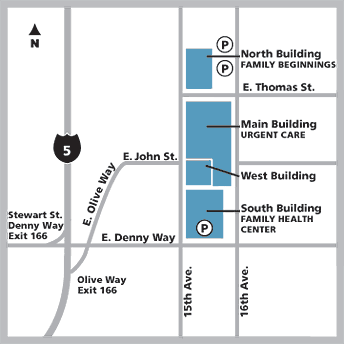
1. On the web: I go to the Group Health website to find directions to the Capitol Hill Clinic and find this map:

The map shows the freeway and the arterial roads near the medical center, and it features big bold circles showing me where I can park a car. It offers no information of any use to me if I arrive by bike or by bus: it doesn't show bike routes, bus stops, sidewalks or crosswalks. 

Below the map are three paragraphs of detailed, turn-by-turn instructions for driving to the clinic from the freeways, and a sidebar details parking rates. There is no mention of biking or walking routes to the medical center, and no mention of bike parking, 

There's a link labeled "elsewhere on the Web" connecting to Metro Transit's Trip Planner, but you have to follow the link to discover the three bus routes that serve the medical center. 

Through this web page, my doctor tells me that driving is the best way to get to the clinic.  If I choose any other means of transportation, I'm on my own.

2. When I arrive at the clinic, I see big signs at each approach to the building telling me where to find car parking.  To find bike parking, I have to search the grounds (see my earlier post for more about bike parking).  I happen to know there's a bike parking area in the garage, but there's no sign to tell me where to find it.  The outside of the building tells me I should be driving.

3. When I'm ready to leave, I find bold signs inside the building pointing me to the parking garage.  If I had arrived by bus, I would not find any signs reminding me where to find the bus stop or telling me which buses serve the clinic.  If I look closely at one of the big facility maps on the wall, I can find a small icon indicating bike parking - but there's no icon for the bike parking inside the garage.  The inside of the building tells me I should be driving.

I'm using Group Health as an example, since that's where my doctor works. I suspect you'll find similar messages encouraging driving wherever you go for healthcare.

My doctor tells me I should stay active.  Your doctor probably wants you to stay active too. The websites our doctors use and the buildings where our doctors work should be reinforcing that message, not telling us we ought to drive.


Sunday, December 30, 2012

Safe Routes to Health, Part 2: Riding a Wheelchair to Health

Terry and Vickie Hoefer running (LEE GILES III/The Peninsula Gateway)

In Gig Harbor, you can get to the local Starbucks in a wheelchair - but not to the local hospital. Can this be true?

A few days ago, I noticed this headline in the Tacoma News Tribune:  Wheelchair training along roads in Gig Harbor area creates a stir.  Terry Hoefer, a young man who uses an electric wheelchair for mobility, has been training for a marathon, driving his wheelchair along the roads of Gig Harbor accompanied by his mother Vickie, who runs alongside. His dad followed in the car, blinkers flashing. Terry trains in order to build up the strength and endurance to sit upright and operate the wheelchair controls for the long duration of a marathon.  Training was going fine until the family was pulled over by the State Patrol for "obstructing traffic."  It turns out the laws governing electric wheelchairs on roadways are confusing and restrictive:
“Basically, we can ride on the designated bike lanes all over, but we can’t ride on a street that doesn’t have a white line,” [Terry's mother] learned this month.
This means Terry's training route needed modification:
Pierce County helped make a local sidewalk wheelchair-accessible, which means they can still run along Burnham Drive Northwest to the local Starbucks, one of their favorite outings. They’ve stopped using another route, to St. Anthony Hospital, because it doesn’t have a legal shoulder or bike lane. Terry Hoefer has spent a lot of time sick at St. Anthony, and it was fun to see him healthy there on their runs, his mom said.
This story is sad and shocking on so many levels.  Why does a person who uses a wheelchair have to study obscure laws and prevail on local authorities just to make a trip out in the community?

And how is it that you can ride a wheelchair to the local Starbucks - but NOT to the local hospital?

Mobility is essential to health.  Everyone who works in that hospital knows that's true.  Shouldn't everyone be able to get to the hospital - or wherever they want to go - on their own power, whether it's walking, rolling in a wheelchair, or riding a bike?  I hope St. Anthony Hospital takes a look at what Children's Hospital in Seattle has done to create safe routes for walking, biking and wheelchairs near the hospital!

I can relate to Terry's story on another level as well.  I've been caring for my mother-in-law, who needs a wheelchair to get around outside the house.  A few days ago she read in the newspaper about the grand opening of the relocated Museum of History and Industry.  "I'd love to go!" she told me.  So we went.

I helped her into her wheelchair, wheeled her down the street to the bus stop, rolled the wheelchair onto the bus, transferred to the South Lake Union Trolley, and got off half a block from the museum.  We had a great time.  This trip didn't involve any exercise for my mother-in-law - I pushed the wheelchair - but it gave her a chance to be out in the community.  She loved the misty rain on her face and the bustle of the crowds at the museum. And for me, the caregiver, it was a refreshing opportunity to get some exercise and have a change of scene.

I'm sure that Terry's mom benefits as much as Terry does from their outings together. Isolation and lack of exercise are huge challenges of caregiving.  Streets that are safe and accessible for people in wheelchairs are critical for the health of caregivers, too.

Thursday, December 13, 2012

Hey Drivers! Did you know you're supposed to YIELD to buses?

Mike Siegel/The Seattle Times
Dear Seattle Times

I'd like to thank your reporter Mike Lindblom for pointing out that bus bulbs are necessary because people who drive cars so frequently fail to yield to buses as the law requires.

Shortly after reading this article, during a 15-minute drive across Capitol Hill, I observed the following:

- a person driving south on 15th Ave. East attempted to pass the #10 bus as it pulled into traffic on 15th. The driver eventually pulled back to avoid crashing into the bus.

- a person driving south on 16th Ave. E. turned left onto eastbound East Thomas as a #43 bus started to pull out from a stop. The driver took up the entire westbound lane to get around the bus, causing oncoming traffic to abruptly stop.

- as the #11 bus dropped off passengers at 23rd and Madison, a person driving a taxi pulled around the bus, crossing the double-yellow center line to do so. Six more people driving cars followed the taxi as the bus started to pull out.

I should mention that I did observe one person driving a car who did in fact yield to a bus. 

Sincerely,
The Transportation Nag

Monday, November 19, 2012

Safe Routes to Health, Part I: Bike Parking

It's healthy to walk and ride bikes, right?  I'm a nurse, and I've never heard anyone in health care argue that it's better to sit in a car.  So it seems to me that health care institutions should be leading the way in making sure there are safe, convenient healthy ways to walk and ride to the places people need to go. And lots of people need to go to health clinics, pharmacies and hospitals - people who work there and people who go to get care.

Seattle Children's has developed an ambitious Transportation Master Plan that not only encourages people who work there to ride bikes and walk, but also invests in Neighborhood Greenways to make walking and biking safer, more convenient and more comfortable for visitors and people who live in the neighborhood.

One highly visible component of Seattle Children's plan is bicycle parking.  The plan calls for 600 bike parking spaces - and at least 100 of those are right at the main entrance to the hospital, almost completely full at my most recent visit.  A prominent sign by the entrance directs visitors to other bike parking areas, and the big neon sign for the parking garage includes a bike icon.  I didn't have my camera along at my last visit, so I'll leave you to imagine the highly visible bike facilities there.

How do Seattle's other healthcare institutions compare with Children's in supporting active transportation?  In this post I'll look at bike parking at two health care campuses near where I live:  Virginia Mason on First Hill and Group Health on Capitol Hill.


This "Patient Bike Rack" sign is at Virginia Mason Medical Center on First Hill.  Nearby, there's a large caged employee bike parking area at the entrance to the main parking garage; this shot shows about half of the many bikes parked there:


 Bike parking is visible from every entrance,  even the Emergency Room.


(I don't mean to imply that EVERYONE should get to the ER by bicycle!  Virginia Mason devotes a lot more space by the ER entrance to ambulance parking than bike parking!)

Signs by outdoor bike racks direct visitors to secure indoor bike parking:


None of the racks I could see as a visitor were completely full, but still it's obvious when you visit Virginia Mason that bikes are considered normal transportation for patients, visitors and employees.

Next I checked out the Group Health main campus on 15th.  Here's one of several small outdoor bike racks. All are barely used (that's my bike!) and inconspicuous from the main clinic entrance:


Small bike icons on campus maps at various locations show where outdoor racks are located - but how would anyone know there's also bike parking in the garage?


I rode into the garage to explore - but first I had to ignore this warning:


The bike parking area is low-ceilinged, dimly lit and sparsely occupied - and to get there I had to wind my way across car lanes:


There's no bike parking at the Urgent Care entrance - but that didn't stop one visitor from parking a bike there anyway:


Group Health is a very visible supporter of bicycle recreation, most notably as the primary sponsor of the annual Seattle to Portland ride - but there is little evidence on the Capitol Hill campus that bicycles are seen as normal transportation, whether for staff, for patients or for visitors.

Active, healthy transportation includes provisions for walking, bike riding, wheelchairs and other mobility aids, and safe, comfortable access to transit as well.  I'll be looking at other ways our healthcare institutions either promote or discourage these components of active transportation in a future post.

Friday, October 12, 2012

STOP! You on the bike - STOP!


If you've ever ridden a bike on the Burke Gilman trail through the University District, you've seen the giant stop signs with flashing lights warning you to stop before you cross Brooklyn Avenue.  You're a law-abiding careful bike rider, so you probably stopped - while all the other reckless people on bikes whizzed on through.  And then one block farther on, you've caught up with all those reckless people again, since they've dutifully stopped at the red light at University Way.

If you were riding the Burke last week, you may have even seen a friendly police officer give a kind but stern warning to one of those other bicyclists:  next time, you'll get a ticket if you don't stop!

I rode the Burke Gilman again today, thinking about this intersection as I rode.  The more I thought, the less I understood WHY there would be a stop sign there at Brooklyn.

Travelers on Brooklyn see this dramatic signage as they approach the trail:


Most people who drive along Brooklyn here seem to think this means they are supposed to yield to bicyclists  - so when I actually stop at the big red stop sign, people approaching in cars impatiently wave me through.

Yesterday, as I rode east from Fremont, I passed through quite a number of other intersections - and at every other intersection between Stone Way and Brooklyn, the Burke Gilman has the right-of-way. Cars crossing the trail must stop at stop signs, even at the busy crossings by Dunn Lumber and the roads that give cars access to Gasworks Park.


I remembered hearing that the 2007 Bicycle Master Plan included something about intersections, so I went on line and looked it up.  You can read the whole section for yourself if you like; it's Appendix H: Roadway Crossing Design for Bicycles.

The relevant section is titled "Mid-block Trail Crossings."  This is a bit geeky, so bear with me. Bicycle trails and roadways are classified according to their importance for transportation.  The Burke Gilman Trail falls in the category of "regional trail."  Brooklyn Avenue is classified as a "minor arterial" - you can look that up for yourself, too if you want.  Here's what the Bicycle Master Plan says about the mid-block crossing of a Regional Trail with a minor arterial:
Regional Trails are effectively principal arterials for bicyclists, but trail user speed
is generally lower than that on Principal Arterial streets. Therefore, Regional
Trails should generally be given priority over Minor Arterials
, Collector Arterials,
and Access Streets. However, if the traffic volume on the street being crossed
exceeds the traffic volume on the trail by 20% or more, the street should be given
priority.  
Doesn't this mean that the Burke Gilman - Seattle's number one bicycle arterial - should be given priority over a dinky little "minor arterial" like Brooklyn?   I haven't measured the traffic volume on Brooklyn, but every time I've been on the Burke Gilman, I've seen way more bikes at this intersection than cars.

Both the people driving cars who yield to trail users, and cyclists who ride across this quiet "minor arterial" without stopping, act AS IF the guidelines in the Bike Master Plan were being followed; that is, they act as if people traveling on the trail had priority over people driving on Brooklyn.  Just one block farther on, the same people who rode on across Brooklyn without stopping wait patiently for the light to change at University and again at 15th.

Rather than ask Seattle Police to ticket people riding bikes across Brooklyn, it would make more sense - and be more in line with the guidelines of the Bicycle Master Plan - to redesign this intersection to give priority to travelers on the trail.

Meanwhile, there are a few people, both on bikes and driving cars, who recklessly roll through the stop lights at University and at 15th. Those are the folks who need to be reminded to share the road safely.